| Mission statement
From March to August 2008, Matthew Swanson and Linda Dix-Cooper will be traveling to Uganda to participate in the Soft Power Health volunteer program, which is based in Kyabirwa, Jinja Province. We will primarily be working as malaria and family planning educators in local communities, though we may also do occasional work with the mosquito-net distribution program and the Kyabirwa clinic. We are both thrilled with the prospect of doing this vital work in such a wonderful setting!
We are raising funds through this website and other activities (carwashes, Christmas caroling, and so forth) to help contribute towards a $3600 donation to Soft Power Health which will cover the costs to the organization associated with our work. These funds will primarily cover work-related travel expenses, as well as support Soft Power Health programs. Any funds raised in excess of this $3600 will also be donated to Soft Power Health.
Please take a moment to browse this website for more information and the status of our fundraising drive. Below is a detailed description of the Soft Power Health project, which has been slightly modified for ease of reading from the original source, the Soft Power Health website. We’ve also uploaded a few photos and set up the donations page, so feel free to contribute! Starting in March, whenever possible we will post diary entries on this site to help keep everyone updated on the status of our project, so check back often. If you have any comments or questions don’t hesitate to contact either Matthew or Linda and we will get back to you as soon as possible.
Malaria facts (see the CDC website, the WHO World Malaria Report 2005, or our links page for more information)
• Malaria is caused by a parasite that is transferred by the female anopheles mosquito.
• Each year, 350-500 million cases of malaria occur worldwide
• Over 1 million children die every year from malaria, mostly in sub-Saharan Africa.
• At least 20% of all early childhood deaths in Uganda are due to malaria.
• Approximately 18% of Uganda’s GDP is spent on malaria treatment and control or lost due to malaria-related causes.
• Malaria is preventable, treatable and curable.
• Education and prevention are the keys to diminishing the malaria problem.
• Mosquito nets help protect people from getting bitten during prime biting hours 10pm-4am, thereby reducing morbidity and mortality associated with malaria.
• One mosquito net costs approximately $6 and can prevent 2 children from getting bitten for 3-5 years.
• For only $14 a year, Soft Power Health can purchase medication to treat malaria for one Ugandan child.
Solution to the malaria problem with the objectives of Soft Power Health in Uganda:
• Educate the local community about Malaria through lectures, demonstrations, and hands on techniques.
• Educate the community about the economic benefits of preventative medicine.
• Reduce infant mortality due to Malaria and other preventable diseases in the Kyabirwa village and the 15 surrounding villages in this part of rural Uganda.
• Increase availability of affordable mosquito nets for rural Ugandans.
• Provide basic healthcare including family planning, prenatal care, vaccinations, HIV/AIDS education, and effective anti-Malarial treatment for rural Ugandans.
• Create sustainable healthcare and health education programs to be run by local Ugandans with help from medical and non-medical volunteers.
What is Soft Power Health? Where will we be working?
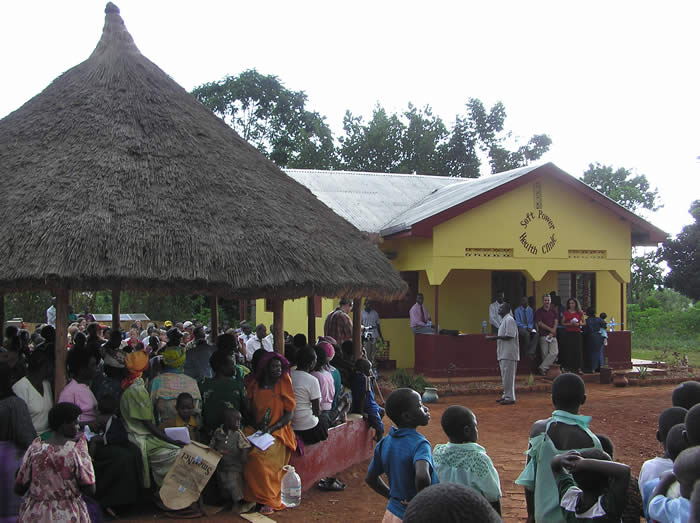
Soft Power Health is a U.S. based non-profit 501 c3 organization that has two main components: the inner city Kids Kayaking Camp that originates from New York City begun in August of 2001 and the Ugandan project which was started in 2004 that provides education, prevention, and treatment of Malaria in rural Uganda. Soft Power Health is working with a Ugandan based non-profit, Soft Power Education to implement various education programs including work with other NGOs. Soft Power Health finished construction of a rural clinic in January 2006 for treating Malaria as well as other common diseases. The creation of sustainable, community-based programs run by Ugandans with training and assistance from our non-profit is in place and will continue to grow in the Kyabirwa village, located two and one half hours east of Kampala next to the White Nile River. This village is a rural farming and fishing village with an approximate population of 2500 people. Kyabirwa is a typical Ugandan village. Villagers live in mud-dung huts, subsistence farm, and have very limited access to education and healthcare.
Click here to see a map of Uganda.
Our work in Uganda will primarily involve a vital element of the fight against malaria: education.
The education and prevention program aims to make villagers responsible for their Malaria prevention with the goal to make the program sustainable and managed by Ugandans. The education sessions explain how the malaria parasite is transmitted to humans and how it makes them ill, and how people can protect themselves from getting malaria in the future. We also discuss the financial consequences of getting sick from malaria and what mosquito nets are for and how to use them. The sessions are lively and interactive with questions and answers, games for the children, and songs about Mrs. Anopheles, the mosquito who carries the Plasmodium parasite. These education sessions take place at local schools, village meeting places and outdoor classrooms. At the end of an education session, participants can purchase subsidized mosquito nets.
In conjunction with the malaria education program, we participate in a family planning education program in an effort to reduce the rate of HIV transmission in Ugandan communities.
We will participate in other aspects of the Soft Power Health program as necessary
1. Data collection.
Soft Power Health began its work by first visiting families in the Kyabirwa village and assessing the cost of Malaria in terms of lives lost, money spent, resources and opportunities lost and disability from the disease. It became readily apparent that no one understood how Malaria was transmitted, thus the importance of sleeping under a mosquito net. After visiting approximately 50 huts, we decided to hold educational sessions for all members of the village at the local preschool school to educate them about the lifecycle of the Malaria parasite and the consequences of the disease in humans. In addition, we trained a Kyabirwa village local, Jessica Mugerwa to be Soft Power Health's Malaria educator for the area. Since that time, we have trained 5 more local educators who collaborate with us. All people who purchase mosquito nets are entered into a data base and are visited in their homes to insure that mosquito nets are hanging properly and to record their incidence of Malaria since hanging their nets. We want to insure that no one is lost to follow up!
2. The clinic.
Through our educational sessions and hut-to-hut visitation, we discovered an enormous need for rural medical care. The nearest hospital is an hour away and very poorly staffed and supplied. Thus, we decided that the construction of a rural clinic would be of enormous benefit to the community. This clinic serves as a treatment center for Malaria and other common diseases and also as a health education center for the village. It is obvious that without the educational portion of healthcare work, the treatment of Malaria and other common diseases will do only temporary good. Thus, Soft Power Health uses the clinic for education, prevention, and treatment of Malaria and other diseases in this part of Uganda. The clinic is run by Ugandan doctors and nurses and provides basic medical care such as vaccinations and anti-Malarial medication for the Kyabirwa village as well as the surrounding villages. The Soft Power Health clinic also serves as a health education center for the local population. The town of Kyabirwa has very kindly gifted Soft Power Health the land where the to the clinic has been built.
3. The mosquito net distribution program.
Since the start, it appeared critical to combine the education and prevention program with easy access to treated mosquito nets. This is why we supply and sell treated mosquito nets to villagers. Now for approximately $1.80 villagers can buy this essential element of their health protection. Soft Power sponsors the difference, which is about $8. To date we have sold over 16,000 mosquito nets. This part of the program is very successful. Follow up has shown that people hang the nets properly and have children and pregnant women sleep under the nets prefernetially. We assess the effectiveness of the net program by returning to each home approximately 3 months after initial implementation of the nets to see if there is reduced incidence of Malaria in families. Of course, this is dependent on proper use of nets and discounting the effects of previously bitten individuals who will manifest Malaria even after sleeping under a treated net.
Conclusion
As Dr. Peter Olumese, a medical officer in the WHO's malaria program, has recently stated, "[t]here has been a paradigm shift" in the progression towards broad and equitable distribution of malaria education and prophylaxis tools, and therefore "[w]e need to use the momentum we have right now" to bring malaria morbidity rates in rural Africa under control. Linda and I believe that our work with Soft Power Health this spring will contribute to this effort to improve the health and welfare of the rural Ugandan population.
|